
Sustainability at 1KOMMA5°Environmental and Social Responsibility
Our Contribution Against Climate Change
Our vision – living on wind and sunlight forever for free – guides us every day, shaping everything we do and how we do it. Our actions are driven by a clear commitment to changing the world for the better. We create impact in two ways: through our products and intelligent solutions, and through our own operations as a company.
On this page, with transparency in mind, we outline our current achievements; as well as our plans to increase corporate sustainability activity impact – backed by numbers and facts.
Our Impact So Far
> 120,000
Homes equipped
> 300,000
Installed, steerable energy systems
> 9.6 Mio
Optimization decisions per day
> 1 GW
Flexibility capacity in our virtual power plant
> 548,000 tons
CO₂ avoided in 2025 · net
> 2.5 Mio tons
CO₂ avoided since 2021 · gross
The Direct Climate Impact of Our Products
1KOMMA5° Solar System
Generates electricity with zero operational CO₂ emissions, directly replacing grid power that today still comes, to a significant extent, from coal and gas. On top of that, our 1KOMMA5° solar modules are manufactured using 100% renewable energy.
1KOMMA5° Battery
Stores surplus solar power generated during the day so it can be used at the most effective moment. This maximizes self-consumption and reduces reliance on grid electricity.
Heat Pump
Heats homes using ambient thermal energy, replacing oil and gas heating systems. We also rely on the refrigerant R290, which has a low Global Warming Potential (GWP) of 3 – an environmentally friendly alternative to common refrigerants such as R-410A, which has a GWP of 2,088.
Heartbeat AI
Heartbeat AI is our energy intelligence enabler. It makes millions of optimization decisions every day based on electricity market prices, weather forecasts, and usage patterns. It connects every component in the home and coordinates them so that clean, self-generated energy is used as efficiently as possible and grid electricity draw is minimized.
Air Conditioning
Paired with clean solar power, this isn't just an energy-efficient way to cool a home – it's also a key tool for climate adaptation as global temperatures rise. Here, too, we use the R290 refrigerant. With a GWP of 3, it has a far lower warming potential than common refrigerants such as R-410A (GWP: 2,088).
Dynamic Pulse
As a dynamic electricity tariff, Dynamic Pulse ensures that power is drawn from the grid when there's a surplus of renewable energy available. This eases pressure on the grid and encourages the use of clean electricity.
EV Charger
Enables low-emission charging as an alternative to the combustion engine. It charges the electric vehicle primarily with the power the rooftop solar system produces. If additional energy is needed, Heartbeat AI's intelligent control system steps in automatically.
How Heartbeat AI Drives Our Impact
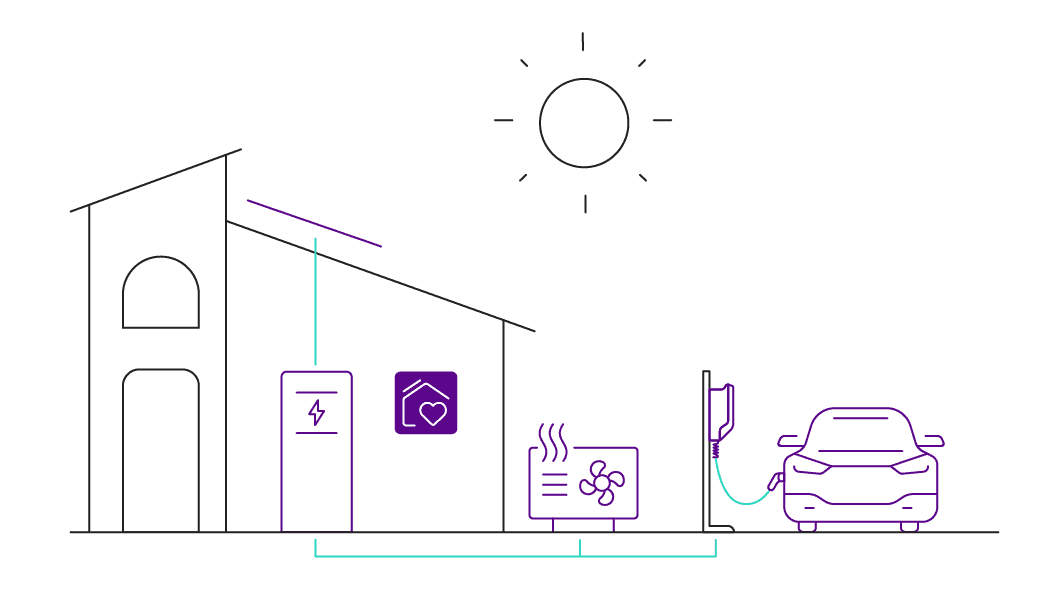
When we talk about our climate contribution and intelligent energy management at 1KOMMA5°, it's backed up with hard technological facts. Heartbeat AI is at the core of this measurable optimization. Our energy intelligence runs fully automated, making sure we deliver on our promise: as much of your own solar power as possible, and as little gray grid electricity as possible.
Optimizing Self-Consumption
When your own solar production peaks, Heartbeat AI automatically routes the surplus energy into the battery.
Using Clean Grid Electricity
When we talk about dynamic optimization, we mean shifting flexible loads into exactly those windows when the public grid is carrying the highest share of wind and solar power.
Stabilizing the Grid
By harmonizing generation and consumption, Heartbeat AI eases pressure on the grid and reduces the need for fossil-fuel backup capacity.
Our Impact Calculation
Our claims about climate protection and avoided CO₂ emissions are grounded in robust, measurable results. In the interest of full transparency, we lay out here in detail the standards behind our calculation of annually avoided CO₂ emissions.
Gross Avoidance
569,279 metric tons of CO₂
Avoided through operations · 2025
Carbon Footprint (Embedded Emissions)
− 21,171 metric tons of CO₂
Caused by our products over their full life cycle, allocated proportionally to 2025
Our Net Impact
= 548,108 metric tons of CO₂
Avoided in one year, after subtracting the emissions caused · 2025
For context: that's comparable to the annual carbon footprint of 79,000 people in the EU.
Our Standard
Clear Separation
We do not net our avoided emissions against our own corporate carbon footprint. The two figures are kept strictly separate, as required by WBCSD guidance.
Conservative Assumptions
In our reference scenario, we exclude the production emissions of fossil-fuel systems, since reliable data isn't available. If we included the embedded carbon footprint of an old oil heating system, our reported avoidance would actually be even higher.
Why We Say "Avoided," Not "Saved"
Saving lowers the emissions of a process that continues to operate. Avoidance means the emissions are never generated in the first place, because a fossil-fuel technology has been replaced by a renewable one. A heat pump that replaces an oil heating system doesn't save oil – it burns none.
Net, Not Gross
To demonstrate our real impact, we draw a strict line between gross and net figures. Every heat pump, every PV module, and every EV charger has to be manufactured, transported, and eventually disposed of – and that inevitably generates emissions. We consistently account for this embedded carbon footprint (a cradle-to-grave approach) and subtract it from our positive balance.
Independently Reviewed
Our methodology follows the WBCSD Guidance on Avoided Emissions v2.0 – the internationally recognized standard for avoided CO₂ emissions. The independent sustainability consultancy ERM reviewed the figures and rated them as best practice, with strong alignment to current WBCSD guidance.
Our Methodology in 5 Steps
A defined time period: We calculate year by year using real data – not projections based on our products' expected lifespan.
Realistic reference scenarios: We compare our solution against what would have happened without it (e.g., the actual 2025 energy mix for heating and hot water, calculated per country for every market we operate in).
Full life-cycle view: We assess both scenarios in full, including production and disposal, combined with the real electricity mix of the respective country and year.
A rigorous net calculation: We calculate the difference and subtract the emissions caused.
A plausibility check: We have independent third parties verify the link between our solution and the emissions avoided.
Our Full Carbon Footprint
We measure all emissions we cause as a company every year. In 2025, that figure came to 173,027 metric tons of CO₂. The calculation covers all three scopes under the GHG Protocol, supported by the climate experts at Code Gaia.

In Short
Looking at our total carbon footprint, one thing is clear: by far the largest share of our emissions comes from manufacturing our hardware – the production of PV modules, batteries, heat pumps, inverters, and EV chargers. That's exactly where our biggest lever for further improvement lies: our supply chain.
The actual usage phase of our systems, by contrast, accounts for only a small share. That's a direct reflection of how effectively Heartbeat AI works: our energy intelligence maximizes self-consumption of solar power and shifts remaining grid draw into hours with a high share of renewable energy.
To paint a complete picture, we also account for every other area – from end-of-life disposal of hardware to our everyday operations, including marketing, consultations, installations, and employee commutes.
On the Path to Decarbonization
We don't just make our carbon footprint transparent – we also take action to reduce it.
In day-to-day operations, for example this shows up in our own vehicle fleet: electric and hybrid vehicles already make up 55% of our fleet today – a 17% relative increase compared to 2024.
We're also continuing to develop our comprehensive decarbonization strategy, with the goal of publishing future targets aligned with the science-based criteria of the internationally recognized Science Based Targets initiative (SBTi). To get there, our primary focus is on close collaboration with our suppliers to drive meaningful change together.
55 %
Share of our vehicle fleet
17 % Relative increase compared to 2024

Supply Chain Transparency
We rely on local supply chains wherever possible. Strong partnerships with manufacturers like Stiebel Eltron for heat pumps and Mennekes for EV chargers – both with production in Germany – show where we're already succeeding.
That said, the market reality of the energy transition also includes a strong global concentration of manufacturing: according to International Energy Agency (IEA) analysis, roughly 85% of the world's solar production capacity is located in China. International sourcing in this industry is unavoidable, and we take an active role in managing that responsibility.

Due Diligence in Our Supply Chain
To uphold environmental and social standards across our entire value chain, we rely on the following mechanisms:
Regular on-site visits
We regularly visit our production facilities to get a first-hand impression on site.
Comprehensive ESG assessments
Our key strategic partners – measured by purchasing volume – undergo an annual sustainability assessment. This annual evaluation covers a broad spectrum of critical ESG criteria, ranging from the origin of raw materials and climate transformation plans to verified audits and occupational safety standards.
Compliance at the highest level
By reviewing risk data and supplier performance directly with leadership, in line with the requirements of the German Supply Chain Due Diligence Act (LkSG), we keep our operations aligned with our long-term commitment to human rights and environmental integrity.
Binding policies and secure whistleblower reporting system
Shared with all our key suppliers, our Supplier Code of Conduct defines the strict environmental and ethical standards we require from our partners. Furthermore, our Policy Statement on Human Rights is publicly accessible to everyone. Additionally, a whistleblower system featuring an independent, external ombudsperson is in place, allowing anyone to report potential violations securely and confidentially.
Further Insights
To document our progress transparently, we summarize our actions and results across Environment, Social, and Governance (ESG) each year in an Impact Report.