
The Duck Curve Explained: How Home Batteries Can Support Australia’s Energy Market
Australia’s energy landscape is undergoing one of the fastest and most dramatic transformations in the world. With more than 3.7 million households now generating their own rooftop solar, we’re seeing the grid reshape itself in real time and one of the clearest illustrations of this shift is the famous solar duck curve.
If you’ve ever wondered why electricity prices swing so wildly through the day, why feed-in tariffs keep dropping, or why batteries are becoming essential in modern solar systems, the duck curve explains it all.
In this guide, we break down what the duck curve is, the challenges it creates, and how home batteries are becoming one of the most important solutions for Australia’s future energy market.
Key Takeaways:
The Duck Curve Creates Daily Challenges: High solar generation during the day and steep evening demand lead to volatile electricity prices and stress on the grid.
Home Batteries Turn Challenges into Opportunities: Batteries store cheap midday solar and release it during expensive evening peaks, saving households money and reducing pressure on the electricity system.
Batteries Support a Cleaner, Smarter Grid: Widespread adoption enables grid stability, lower emissions, increased renewable use, and the potential for a decentralised energy system powered by everyday Australians.
What Is the Duck Curve?
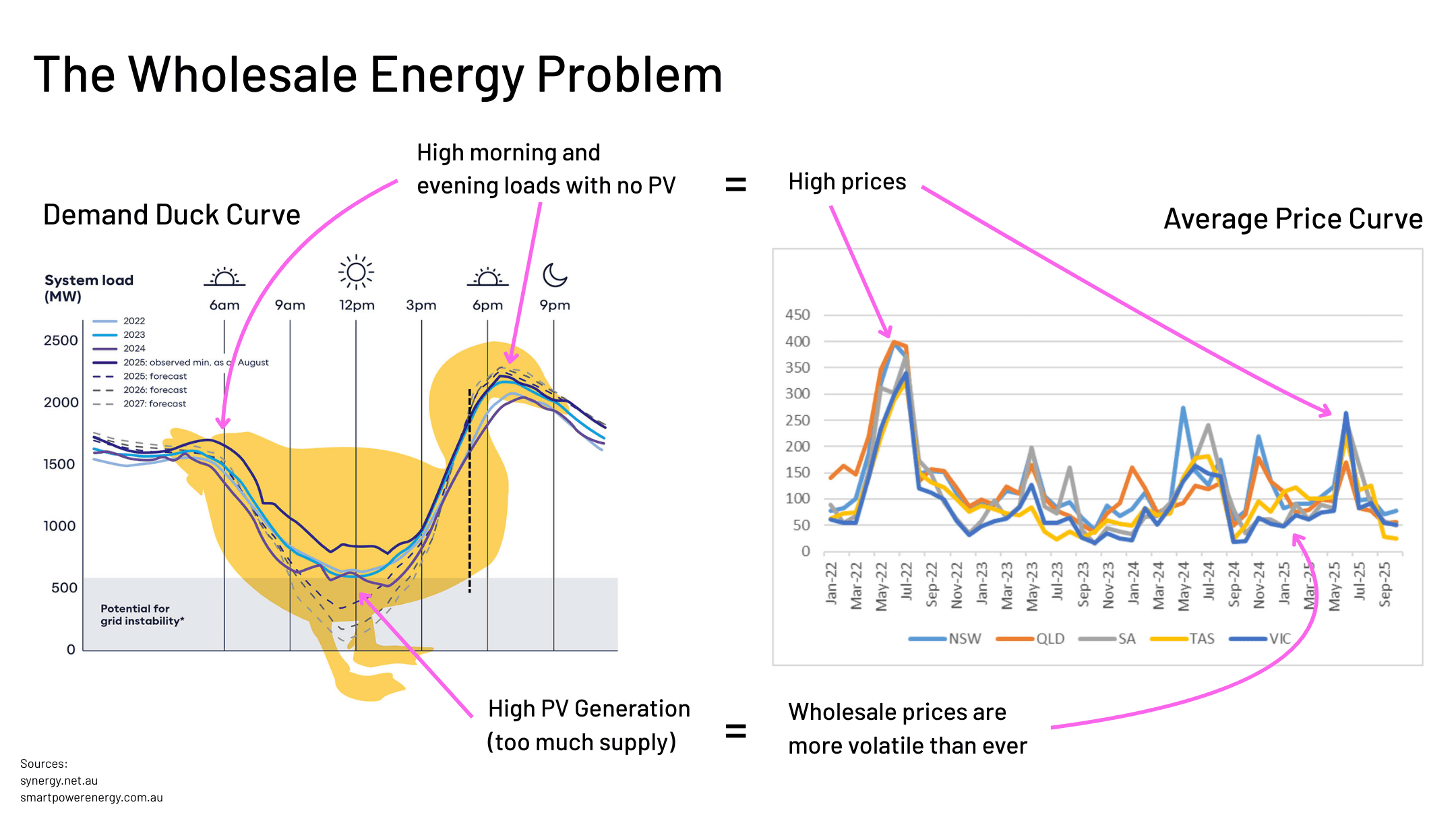
The term duck curve (sometimes referred to as the solar duck curve) was first used in California to illustrate how increasing rooftop solar changes net electricity demand across the day. Essentially, the curve shows a dip in grid demand during the middle of the day when solar production is at its peak, followed by a rapid rise in demand in the late afternoon and evening as people return home and the sun sets.
When you plot this shape across the hours of the day, the curve looks like the silhouette of a duck:
The belly (midday) dips low because there is so much rooftop solar
The neck (late afternoon) rises sharply as sun disappears
The head (evening) peaks during the busiest hours when households cook, cool/heat, and run appliances
This exaggerated drop-and-surge pattern affects everything from wholesale electricity pricing to grid stability, which is why the duck curve is now one of the most widely discussed challenges in Australia’s energy market.
How the Duck Curve Affects Electricity Pricing
Electricity prices are directly influenced by supply and demand. During periods of high solar generation, such as around midday, the abundance of electricity can push wholesale prices down, sometimes even into negative territory. Conversely, in the evening, as solar production fades and demand rises sharply, wholesale prices can spike.
This creates a daily pattern of price volatility that can be confusing for households and challenging for grid operators. Homeowners might see that their solar exports are generating minimal revenue during the day, yet they still pay high prices for electricity once the sun goes down. For retailers and generators, the duck curve represents both an operational and economic challenge: they must balance supply and demand across the day while managing financial risks created by the steep swings in wholesale prices.

Midday – Too Much Solar + Low Demand = Very Low Prices
When rooftop solar floods the grid, demand for grid-supplied electricity collapses. This oversupply pushes wholesale prices down, sometimes even below zero in states like SA or VIC.
This is why:
Feed-in tariffs have fallen sharply
Energy retailers pay almost nothing for surplus solar
Households exporting solar receive far less value than they used to

Evening – No Solar + High Demand = Very High Prices
After sunset, everyone comes home and turns on their appliances and heating/cooling. At the same time, solar generation disappears completely, meaning we rely on the grid again.
This leads to:
The highest prices of the day (5–8 pm)
Increased pressure on gas-fired peaker plants
More volatility when demand spikes suddenly
Why Feed-In Tariffs Are Falling Fast (and How the Duck Curve Drives It)
Feed-in tariffs were originally created to reward early solar adopters. Back then, solar was rare, and the grid genuinely benefited from extra daytime energy so retailers paid very generous rates.
Today, the situation has completely flipped.
With millions of homes exporting solar at the same time, feed-in tariffs are falling fast because:
There’s now too much solar in the middle of the day
Wholesale electricity prices often drop to near zero or even negative at midday
Retailers can’t pay more for solar than what the market is actually worth
More supply = lower value for every exported kilowatt-hour
This downward trend is expected to continue long-term. The duck curve makes it inevitable. The deeper the midday “solar belly,” the lower the export value.
A home battery turns this challenge into an opportunity by capturing excess solar at zero cost and shifting it to the high-value evening peak. It means you use more of your own energy, rely less on the grid, and get far better savings than relying on feed-in tariffs alone.
A Simple, Real-Life Example

Meet Jess, a typical solar homeowner living in Sydney, NSW. Jess installed rooftop solar a few years ago and loves generating her own clean energy but lately, she’s noticed her feed-in tariff has dropped, and her evening electricity bills are still high. This is the duck curve in action.
A Day in Jess’s Life Without a Battery
12:30 pm: The sun is at its peak, and Jess’s solar panels are producing more electricity than she can use. She exports the surplus to the grid, earning just 5–6 cents per kilowatt-hour.
6:30 pm: Jess comes home, switches on the lights, air conditioning, and starts cooking dinner. At this time, her solar panels no longer generate power, so she must buy electricity from the grid at 40–55 cents per kilowatt-hour, depending on peak pricing.
Even though she’s generating solar energy all day, Jess is still paying a lot for electricity in the evening, a direct result of the duck curve. Her cheap solar is produced when demand is low (midday), and she buys expensive electricity when demand is high (evening).
How a Battery Changes the Game
Now imagine Jess installs a home battery:
During the day, the battery stores the 5c/kWh solar energy that would otherwise be exported at low value.
In the evening, instead of buying expensive electricity from the grid, Jess uses her stored solar energy, effectively turning low-value midday electricity into high-value evening power.
The result:
Jess avoids paying peak electricity prices
She gets more value from her solar panels
She reduces stress on the grid by using energy when it’s most needed
In simple terms, a home battery flips the economics of the duck curve: it turns the “cheap solar midday belly” into “high-value evening energy,” saving money and helping the entire electricity system run more smoothly.
How Household Batteries Can Flatten the Duck Curve
Home batteries are emerging as one of the most effective solutions to the duck curve. By storing excess solar energy during the day and releasing it in the evening, batteries help reduce the extremes of the duck curve while providing multiple benefits to households and the electricity system.
During the day, batteries charge using surplus solar energy, absorbing electricity that would otherwise be exported to the grid at low or negative prices. This process lifts the “belly” of the duck, reducing curtailment of solar and increasing the utilisation of renewable energy. In the evening, batteries discharge stored energy to meet household demand, reducing reliance on the grid and softening the sharp rise in demand or the “neck” of the duck.
When aggregated across thousands of households, this behaviour can significantly reshape the net-load profile seen by the grid, reducing the need for fast-start peaker plants, lowering wholesale price spikes, and contributing to a more stable and reliable electricity system.
| Time of Day | Solar Production | Grid Demand | Wholesale Prices | What Happens |
|---|---|---|---|---|
| Morning (6 AM-10 AM) | Increasing | Steady | Moderate | Solar begins offsetting household consumption |
| Midday (10 AM-3 PM) | Maximum | Very low | Very low or negative | Grid flooded with solar. FITs lowest. Exports lose value |
| Late Afternoon (3 PM-5 PM) | Falling quickly | Rising | Increasing | Solar drops as households return home |
| Evening Peak (5 PM-9 PM) | Zero | Highest | Highest | Gas peakers turn on. Biggest price spike of the day |
| Night (9 PM-6 AM) | Zero | Low | Moderate | Grid demand tapers. Loads shift where possible |
Benefits of Home Batteries
Beyond reducing price volatility and evening peaks, home batteries offer several other benefits:

Enhanced grid stability: Batteries can respond instantly to fluctuations in frequency and voltage, helping the grid operate reliably even during rapid changes in solar output or unexpected demand spikes.
Reduced emissions: By shifting solar energy to evening periods that would otherwise be served by fossil fuel generators, batteries lower the overall carbon intensity of the electricity system.
Lower electricity costs for households: Using stored energy in the evening reduces grid reliance, meaning homeowners can avoid paying higher peak electricity rates.
Deferral of network upgrades: By lowering local peak demand, batteries reduce stress on distribution networks, potentially delaying or downsizing costly infrastructure upgrades.
Increased renewable utilisation: Batteries help absorb excess solar energy that might otherwise be curtailed, maximising the value of renewable generation and contributing to a cleaner energy system.
Risks and Policy Considerations
Despite the clear benefits, there are some challenges and risks associated with widespread battery adoption:
Price shifting: If large numbers of batteries charge or discharge simultaneously, new peaks could form, potentially creating unforeseen pricing or operational challenges.
Market volatility: Batteries responding solely to retail price signals may inadvertently destabilise short-term electricity pricing.
Policy lag: Current market rules and tariffs were not designed for millions of distributed storage devices, requiring regulatory updates.
Equity issues: Access to home batteries is currently skewed toward wealthier households, which could create uneven benefits if not addressed.
Reliability limits: Batteries alone cannot cover multi-day periods of low solar availability, meaning firm generation is still necessary for long-term system reliability.
To maximise benefits, policymakers can introduce measures such as dynamic pricing, time-of-use tariffs, virtual power plant frameworks, improved visibility of distributed energy resources, and equitable incentive programs.
The Long-Term Vision: A Decentralised Energy System
Looking ahead, Australia’s electricity system is likely to become increasingly decentralised, with millions of small, customer-owned batteries working together to support grid operations. In this vision:
Virtual power plants (VPPs) coordinate thousands of batteries to provide grid services, invisible to the homeowner but valuable to the system.
Networks act as platforms that procure flexibility services rather than relying solely on centralised energy generation.
Households gain control over energy costs while simultaneously contributing to a more stable, low-carbon grid.
Over time, this distributed approach could significantly reduce reliance on fossil fuel generators, lower emissions, and enable a higher share of renewable energy in the mix, fundamentally reshaping how Australia produces and consumes electricity.
Conclusion: Why Home Batteries Are the Future
The duck curve reflects a structural shift in how Australia generates and uses electricity. As rooftop solar continues to grow, the gap between midday oversupply and evening demand becomes more pronounced, placing pressure on pricing, grid stability, and long-term system planning. Home batteries offer a practical, scalable solution by storing excess solar when it has low market value and shifting it to the periods when households and the grid need it most.
At 1KOMMA5°, our focus is on helping Australians make the most of this transition. We offer solar and battery systems that deliver strong long-term performance, greater energy independence, and meaningful bill savings. More importantly, they position households to play an active role in the shift toward a smarter, decentralised, and renewables-driven energy system.
For homeowners looking to future-proof their energy use, storage is quickly becoming an essential part of the modern solar system and a straightforward way to support a cleaner and more resilient electricity grid.
More Helpful Articles:

1KOMMA5° Blog
Need more information?
Head over to the 1KOMMA5° blog for more helpful tips and other important guides on everything solar, from inverters, panels and batteries to how to make the most of your investment for years to come.